.png)
The Front Door Problem: Fragmentation, Variability, and Burnout
High-quality care depends on a complete, accurate patient history, yet for many health systems, the front door remains fragmented. Intake workflows vary by site, channel, and staff experience level. Call centers are overwhelmed. Nurses and MAs spend valuable time gathering information that’s often incomplete, inconsistently documented, or disconnected from downstream workflows.
The result?
- Missed or delayed red flags
- Longer visit and call times
- Provider frustration with EHR documentation
- Inefficient routing across care settings
Health systems don’t just need faster workflows; they need safer, standardized ones.
That’s where Clearstep’s AI Intake + AI Triage + Clinical Decision Support comes in — not as a replacement for clinicians, but as a workflow intelligence layer that standardizes how patient data is captured, assessed, and handed off across access and care teams.
Why Workflow Automation Alone Falls Short in Healthcare
For years, healthcare workflow automation focused on administrative tasks: reminders, static forms, basic scheduling. Helpful, but insufficient. These tools automated tasks, not clinical thinking, and often shifted burden rather than removing it.
Clearstep represents a different category: clinical workflow optimization, where automation is paired with evidence-based clinical logic at the point of intake and triage. Instead of collecting data and leaving interpretation to already overloaded staff, Clearstep’s platform:
- Guides patients, MAs, or call-center agents through clinically validated intake and triage flows.
- Structures data into chart-ready formats.
- Surfaces acuity signals and red flags early.
- Supports smarter routing, scheduling, and escalation decisions.
This is healthcare workflow automation that actively improves safety, consistency, and throughput.
Digital-First Intake: The New Clinical Starting Line
Clearstep transforms intake from a bottleneck into a digital-first clinical foundation. Through web, chat, or voice-based experiences, patients (or staff on their behalf) are guided through a standardized, conversational intake process built on peer-reviewed protocols used in millions of real-world encounters.
Key capabilities include:
Guided Intake for Patients and Staff
- Patients share their story once, so there’s no repetitive questioning.
- MAs and access agents follow guided, protocol-driven workflows.
- Intake adapts dynamically based on symptoms and responses.
Structured, Clinically Useful Data
- Intake outputs structured HPIs and coded data.
- Information flows cleanly into downstream workflows.
- Providers start visits with a clearer clinical picture.
This standardized approach reduces variability across sites and staff experience levels — a major source of risk and inefficiency.
AI Triage That Supports Safer Access Decisions
Clearstep’s AI triage capabilities are designed to support safe, appropriate routing, not to replace clinical judgment. Across access channels (call centers, digital front doors, virtual care), the platform helps:
- Identify potential red flags early.
- Prioritize higher-acuity cases.
- Route lower-acuity needs to appropriate care settings.
- Reduce unnecessary ED or urgent care utilization.
In emergency department and urgent care contexts, artificial intelligence in triage plays a critical role in early risk identification. Clearstep’s triage logic continuously evaluates symptom combinations against evidence-based criteria, ensuring escalation pathways are clear and defensible.
This approach helps health systems balance access, safety, and cost without introducing clinical blind spots.
Embedding Intelligence Directly in the EHR
Clearstep is designed to work inside existing clinical and access workflows. All intake data, triage outcomes, flags, and recommendations can be written back into major EHRs (including Epic, Cerner, Athenahealth, and others), enabling:
- Fewer clicks and less duplicate documentation.
- Cleaner handoffs from intake → provider → follow-up.
- Consistent clinical context across teams and settings.
By delivering structured data directly into the EHR, Clearstep reduces administrative burden and supports better clinical continuity, a key driver of provider satisfaction and retention.
Operational Impact That Compounds Over Time
The benefits of AI-enabled, automated intake and triage extend well beyond the first interaction. Health systems using Clearstep see improvements across:
Throughput and Capacity
- Faster intake and call resolution
- Earlier routing and scheduling
- Reduced congestion in higher-acuity settings
Provider and Staff Experience
- Less manual documentation
- Fewer repetitive questions
- More time focused on patient care
Risk and Consistency
- Standardized intake reduces missed red flags
- Evidence-based workflows lower variability
- Clear escalation paths support safer access decisions
This is where AI in healthcare administration delivers real value: by improving both operational performance and clinical confidence.
These operational improvements are supported by clear, measurable metrics:
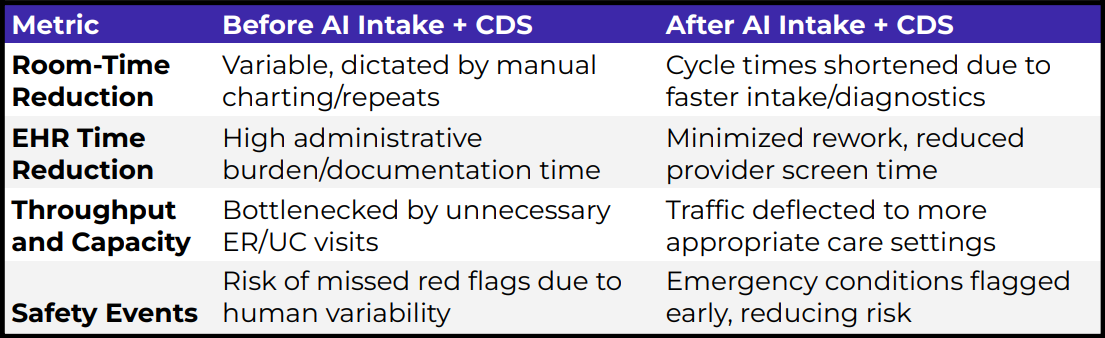
These efficiencies prove that high-quality, standardized care can also be the most efficient care, driven by smart workflow automation in healthcare.
A Playbook for Healthcare Workflow Automation
Healthcare organizations succeed when adoption starts with focus.
1. Start at the Front Door
Patient intake and triage are the highest-leverage places to deploy AI. Improvements here ripple downstream across access, utilization, and documentation quality.
2. Position AI as Augmentation
Clearstep augments — not replaces — clinicians and staff. Framing matters. When teams see AI as a safety net and productivity booster, adoption accelerates.
3. Measure What Matters
Beyond deflection, track:
- Call and visit cycle times.
- Routing accuracy.
- Documentation completeness.
- Staff satisfaction and burnout indicators.
What ‘Good’ Looks Like Within 6 Months
After six months with Clearstep, health systems typically see:
- Standardized intake across sites and channels.
- More consistent triage and routing decisions.
- Cleaner EHR documentation upstream.
- Faster access experiences for patients.
- Reduced administrative load for staff.
It’s not a wholesale clinical transformation overnight, but measurable, sustainable gains where they matter most.
Ready to Modernize Patient Access?
The pressures facing health systems aren’t slowing down. Fragmented intake and access workflows are no longer sustainable.
Clearstep’s AI Intake + AI Triage + Clinical Decision Support provide a practical, scalable way to standardize workflows, improve safety, and support teams at the point of first contact.
From intake to access, Clearstep helps ensure no step is missed.
Schedule a demo to see how AI-driven workflow automation fits into your access and care workflows.


%20(1).jpg)

%20(1).png)